 mvp pricing — 2026
Here's what building an MVP actually costs in 2026.
Not $10K. Not $500K. The number depends on exactly three things — and we’ll tell you which bucket you’re in before we get on a call.
5 questions. 2 minutes. Real range, not a quote bucket.
 the problem
Why you’ve seen quotes from $5K to $500K
for the “same” thing.
Most agencies quote a number before they understand your product. They’re pattern-matching to their last project, not yours. That’s how you end up with a $12K no-code Bubble build that falls apart in six months — or a $180K enterprise engagement for an idea that needed eight weeks of validation first.
MVP cost has three real drivers:
Complexity
What you're actually building — auth, AI, payments, multi-role.
Discovery quality
How well-defined the hypothesis is before code is written.
Code standards
Vibe-coded slop vs. production-grade architecture.
A team that skips discovery and ships vibe-coded AI slop can quote you $15K and hit it. A team building production-grade code with real architecture can quote you $60K and also hit it. The question isn’t the number. It’s what you’re buying.
We give you a real range before we ever get on a call — based on 14+ projects we’ve actually shipped. Then we scope it to your hypothesis. Not our billing rate.
real rangesFour build types. Real ranges.
The most common question we get: how much does it cost to build an MVP? Here are the four build types we work on, with real ranges based on actual project data. These aren't estimates pulled from air — they're what we've shipped.
Validation MVP — one flow, one hypothesis
You have a hypothesis. You need to know if anyone will pay for it before you build the full thing.
A deployed product — real URL, real users, real data. One core flow, fully functional. Not a landing page with a waitlist. Not a Figma prototype you show investors. A working thing you can put in front of customers this week.
Still asking "will anyone pay for this"? Start here.
- Core user flow, deployed to production
- Analytics so you know what users actually do
- 2 weeks post-launch support
- Full IP ownership from commit one
SaaS MVP — auth, billing, dashboards
You've validated the idea. You know what you're building. You need to ship it — and ship it in a way that holds up when real users show up.
The full product. Auth, dashboards, core feature set, billing, admin panel, CI/CD pipeline. Everything your first 500 users need. Built on Next.js, NestJS, PostgreSQL, GCP. Not a demo. Not a prototype. A product.
You've done the interviews. You know what you're building. This is the one.
- Production-grade codebase (clean enough that your next hire can read it)
- Stripe billing and subscription management
- User roles and permissions
- Automated deployment pipeline
- Architecture documentation
- 2 weeks post-launch support
AI-Native MVP — the AI is the product
The AI isn't a feature. The AI is the product.
Everything in the SaaS MVP plus a real AI layer — custom LLM integration, RAG pipelines, semantic search, document processing, or generative workflows depending on what you're building. Not OpenAI bolted on at the end. Designed into the architecture from day one.
If the AI is the product — not a feature bolted on later — build it here.
- Everything in SaaS MVP
- AI pipeline architecture (built for reliability, not just demos)
- Model integration — OpenAI, Claude, Vertex AI, or your own
- Token cost monitoring and optimization
- Evaluation framework so you know when the AI breaks
Marketplace MVP — two sides, split payments
Two sides. Two sets of users. One platform that has to serve both.
Marketplaces are architecturally more complex than SaaS — matching logic, payment splits, review systems, trust infrastructure, multi-role admin. We've built them. We know where they break if you don't plan for it early.
Two user types, one platform. We've built them. We know where they break.
- Multi-role architecture with buyer/seller/admin flows
- Stripe Connect for payment splits
- Matching or listing logic
- Real-time features where needed
- Admin controls for both sides
- Scalable data model that doesn't fall over when inventory grows
Building an AI-powered marketplace? The tiers stack. Tell us and we'll price the overlap.
Every project starts with a scoping phase — included in cost, runs 1–2 weeks. We won’t give you a precise number until we know exactly what you’re testing and what “done” means. These ranges hold for 90%+ of what we’ve shipped. If your project falls outside them, we’ll tell you why.
every timeWhat you get. Every time.
No add-ons.
Every build ships with this — not on the enterprise tier, not as an upgrade. Every one. We don't build throwaway prototypes. If it ships under our name, it's production-intent code.

Working product in production
Not a staging link. A real URL with real users.

Full IP ownership from day one
No licensing clauses. No proprietary framework lock-in.

Clean, readable codebase
Your next developer can actually read what we built.

CI/CD pipeline set up
Your team deploys without calling us.

Architecture documentation
What we built, why, what to watch when you scale.

Two weeks post-launch support
Launch bugs are on us — every time.

User feedback built in
See what people actually do, not what you assumed.
Full handoff session
We walk your team through every architectural decision.
That’s not a premium. It’s the minimum.
proofReal projects. Real numbers.
“The first thing we noticed was that the Replit codebase had no tests.”
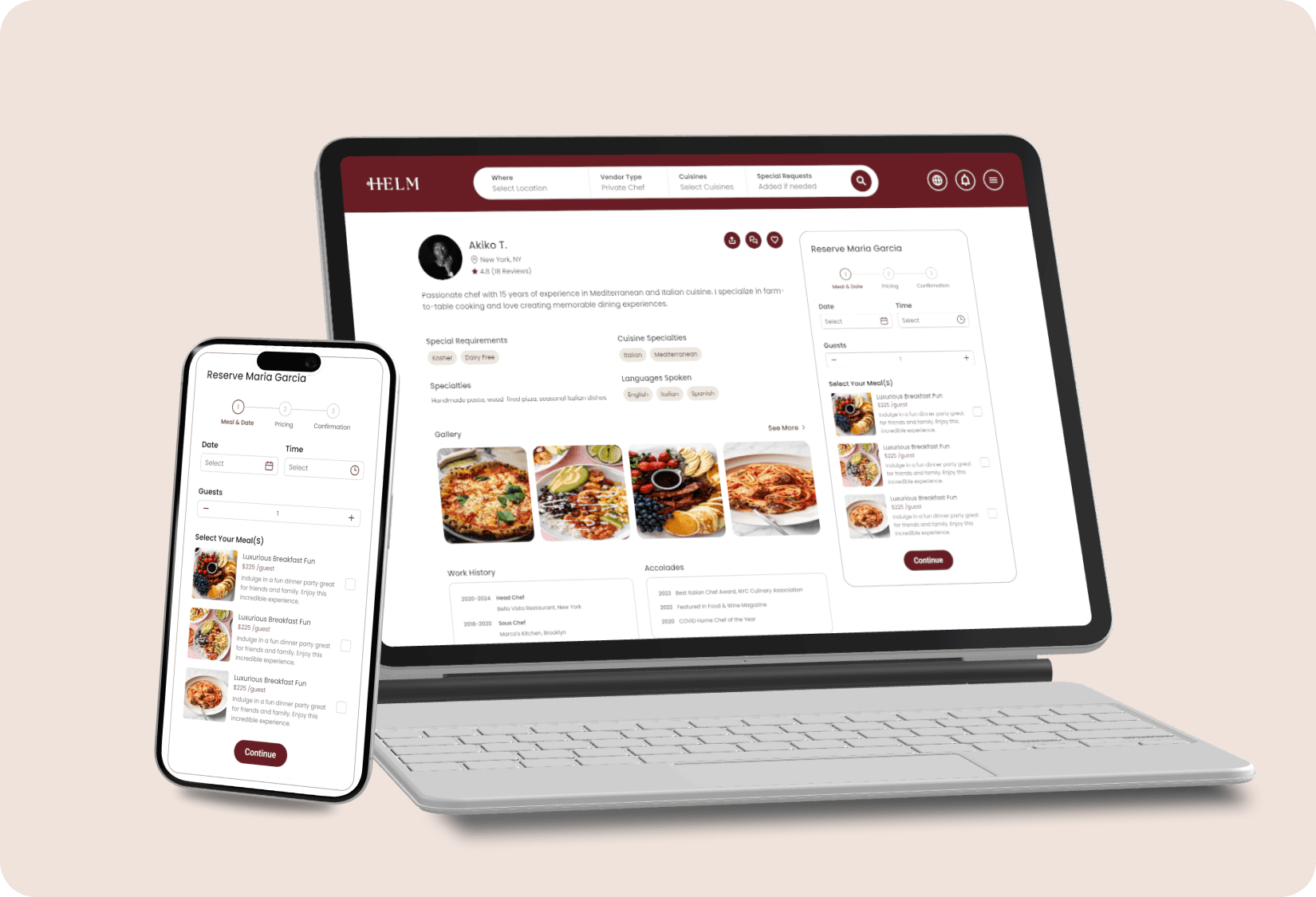
Helm came to us with a hospitality marketplace — booking chefs, valets, and hospitality staff — that had been built fast and was already falling apart. The infrastructure couldn't handle real usage. The architecture couldn't be extended without risk.
We rebuilt it. Completely. Three dashboards, full authentication, real-time booking logic, scalable data architecture on GCP. 12 weeks, start to production-ready. Zero major incidents during delivery.
WaterUp
Compliance SaaS · currently in betaReplaced a spreadsheet-based CCR compliance process with a step-based SaaS platform — templates, validations, audit trails.
Zapbook
B2B SaaS rebuild · live April 2026Embedded as a 4-person backend team. Redesigned and rebuilt an aging platform without downtime.
the mathThe $50K MVP that ends up
costing $200K.
Here’s what the call usually sounds like.
A founder paid $40K to an agency that promised “MVP in 3 weeks.” They delivered something. It ran. It demoed well. Six months later, it broke under real users. No documentation. Architecture that made sense at $40K and none now. The agency stopped responding. Then the founder calls us.
Figures are illustrative, based on patterns we’ve seen across projects.
The cheap option isn’t cheaper. It’s more expensive later, when the stakes are higher.
No-code for custom logic
Bubble and Webflow work until they don't. The moment you need custom auth, complex data relationships, or logic the platform didn't anticipate, you hit the wall. The rebuild costs the same as building it right the first time.
No discovery phase
The fastest way to build the wrong thing is to start before you've defined what right looks like. These teams don't move faster. They move confidently in the wrong direction.
No architecture docs
The next developer inherits a codebase with no map. Every decision gets reverse-engineered. The original dev's intuitions are gone and you pay for them again.
We’re not the cheapest option. We’re not trying to be.
We’re the ones you don’t have to hire twice.
how it worksFrom first conversation
to shipped product.
Scope call
We ask about your hypothesis, your users, and what "working" means for this version. Not your tech stack. Not your Figma file. The business problem you're trying to test.
“If the scope is clear, you'll know your range by the end of the call.”
Written plan
You get a written scope: the features we're building, the timeline, the cost, and a clear statement of what this MVP is designed to validate.
“Not a 40-page proposal. A document you can act on.”
Sprint-based build
We ship working features every week. Not progress updates. Not Figma revisions. Working software. If something changes mid-build, we adjust in the next sprint.
“No change order drama. No six-week blackout before you see anything.”
Launch & handoff
We deploy. We monitor the first 72 hours. We run through the full architecture with your team — what we built, how it works, where to extend it.
“After two weeks, you own it completely. No retainer required.”
faqQuestions we actually
get asked.

Don’t see your question?
Tell us what you’re trying to figure out. We’ll be straight with you.
Ask us anything →How quickly can you start?
Usually within 1–2 weeks, depending on what's in our current pipeline. The first call happens within 48 hours of reaching out. If you're working against a hard deadline — investor demo, product launch, board presentation — tell us upfront. We'll be straight with you about whether it's achievable.
We got burned by an agency before. Why is this different?
Because that's the most common thing founders say when they reach out to us. It's exactly why architecture documentation, handoff sessions, and full IP ownership are standard — not upsells. The goal is for you to be completely independent of us the moment the engagement ends. If we've done the job right, you don't need us to keep the lights on.
What tech stack do you use?
For most SaaS products: Next.js, NestJS, PostgreSQL, deployed on GCP via Cloud Run. For AI-native products, we layer in Vertex AI, RAG pipelines, and model integrations — OpenAI, Claude, or your own — based on what the product needs. We recommend based on your context, not what's easiest for us to build. If you have existing infrastructure, we'll work within it.
Do we own the code?
100%, from day one. Not on final payment. Not on project completion. From the first commit. No proprietary frameworks. No licensing clauses buried in the contract. Your codebase is yours.
What happens if the scope changes mid-build?
It will. That's not a failure — that's a product. Scope changes get handled through sprint planning. We review together, reprioritize, and adjust the next sprint. We don't issue change orders that balloon your budget every time you learn something new. If something fundamental shifts — the core hypothesis changes, a competitor moves, a key stakeholder changes direction — we scope-review together before we build anything that might not matter.
What's the minimum engagement?
For a full SaaS build, we start at four committed sprint weeks. For a validation MVP — a deployed product designed to test one hypothesis — we can move faster. Tell us what you're trying to learn, and we'll tell you what the right scope looks like.
Last updated:
let’s figure it outLet's figure out what you actually need.
Most founders who reach out aren’t sure whether they need a $15K validation build or a $65K product. That’s fine. That’s exactly what the first call is for.
No pitch. No proposal before we talk. Just a conversation about what you’re trying to test, what constraints you’re working with, and whether this is the right fit. If it’s not, we’ll tell you that too.
No commitment. No NDA required. If we’re not the right fit, we’ll tell you.