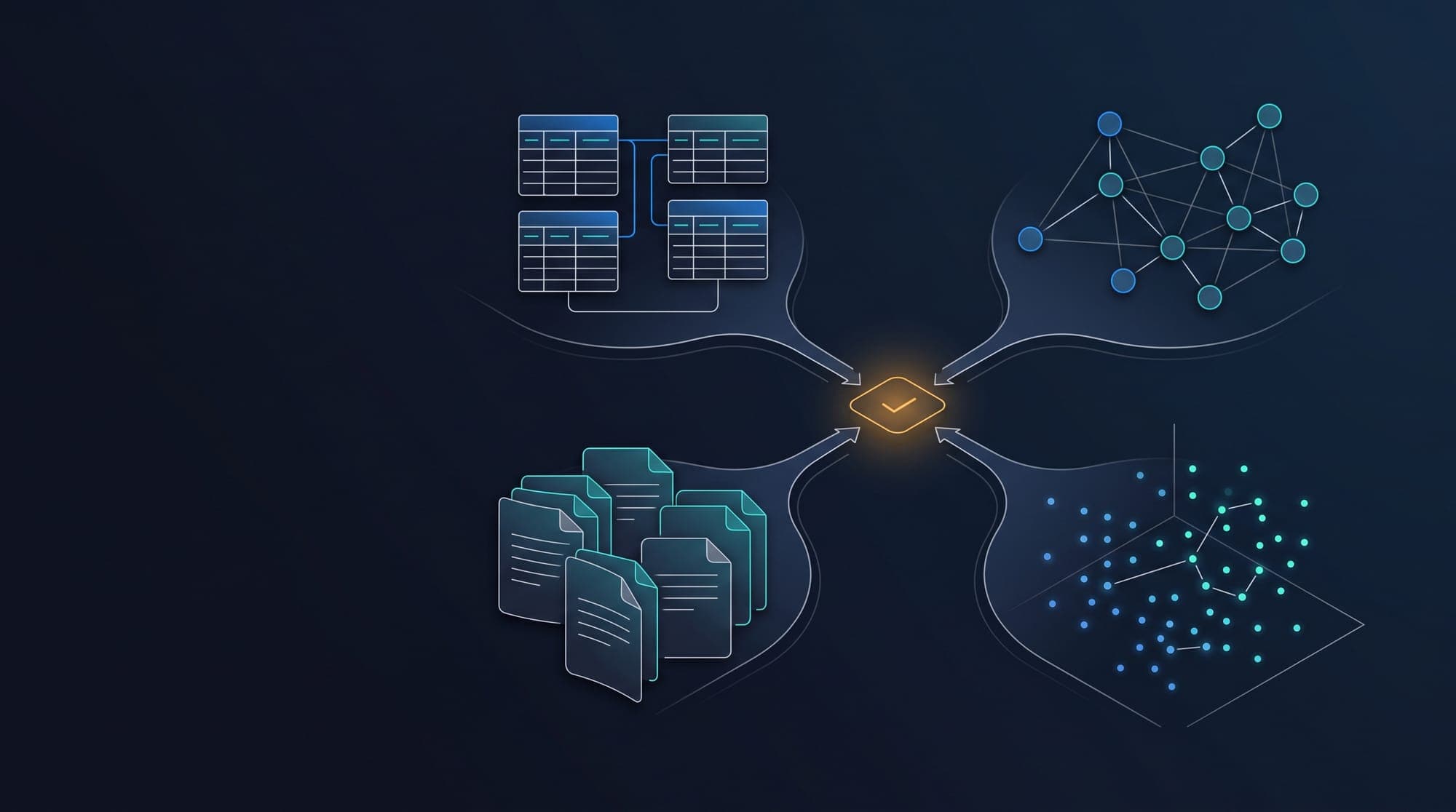
The Database Selection Framework for SaaS in 2026
Most SaaS teams pick MySQL or PostgreSQL by default, then pay for it later. Here's the framework I use to choose the right database before scaling bites.
Every new SaaS project starts the same way. Someone runs docker run postgres or spins up a MongoDB Atlas cluster, and the decision is made in about four minutes, usually based on whatever the team used last time.
For most products, that's fine. It's fine for a year, sometimes two. Then a specific week arrives: a customer complains that dashboards take forty seconds to load, or the product team wants semantic search and the current database has no idea what a vector is. That's the week the "we'll deal with it later" data layer stops being free.
That risk isn't hypothetical. A 2025 survey of 300+ IT leaders by Caylent found that 94% of database migration projects miss their deadlines, and 46% experience five or more hours of downtime during cutover, with 49% reporting a direct revenue hit as a result. That's rarely because the original database was bad. It's because nobody matched the engine to the access pattern before the data outgrew it.
So how do you actually choose, before the pain shows up? Not by picking the database you're most comfortable with, and not by picking whatever's trending this month. You ask four questions about how your data behaves, then match the engine to the answer. Here's that framework, along with the real trade-offs, including cost, across relational, document, graph, and vector databases.
Why the default breaks
The failure mode is almost never "wrong database." It's mismatched access pattern.
A team picks MongoDB early because the schema is still moving fast during the MVP. Eighteen months later, the product needs reporting across five related entities, orders, customers, line items, refunds, support tickets, and half the application layer turns into hand-rolled joins that a relational engine would have done for free. Or a team picks a single Postgres instance, writes scale past what one primary can absorb, and now sharding is an emergency project instead of a planned one.
Neither team chose a bad database. They chose one without asking what shape the data would take at 10x.
The framework: four questions before you touch a database
- What's the access pattern? Are you mostly joining related entities, or moving self-contained documents in and out?
- How strict does consistency need to be? Does a write need to be immediately visible everywhere (billing, inventory), or can it lag by a few hundred milliseconds (an activity feed)?
- What does query complexity look like at 10x the data? Ad hoc analytical queries, or mostly fetches by a known key?
- Is there a semantic or AI layer? Similarity search over embeddings, or is everything still exact-match and keyword search?
Answer those before you open a terminal. The rest of this is what each answer actually costs you, engine by engine.
Relational: PostgreSQL vs MySQL, what's actually different
Both are mature, ACID-compliant relational engines, and both will run a typical SaaS product perfectly well for years. The real debate isn't which one is "better." It's which one avoids making you pay twice as you scale. Four things matter here: replication, sharding, query optimization, and indexing.
Replication. MySQL's primary-replica replication has existed since the early 2000s, and every managed host, RDS, Aurora, PlanetScale, DigitalOcean, treats it as a first-class default. Setup cost is close to zero. PostgreSQL's streaming replication is equally mature, and it adds logical replication on top: you can replicate specific tables or schemas instead of the whole cluster. That's genuinely useful for feeding a reporting replica, migrating a subset of data, or running a zero-downtime major-version upgrade. MySQL wins on out-of-the-box simplicity; Postgres wins the first time you need something more surgical than "copy everything."
Sharding. Neither engine ships native cross-node sharding. MySQL's path is Vitess, built at YouTube and now running Slack's and Square's infrastructure, and PlanetScale packages it as a managed product so you get sharding without operating Vitess yourself. Postgres's path is Citus, now open source and Microsoft-owned, available managed through Azure. The honest cost driver isn't MySQL versus Postgres here. It's whether you can buy sharding as a managed product or whether you're operating Vitess or Citus yourself, which is a real multi-month platform investment either way.
Query optimization. Postgres's planner has historically handled complex multi-table joins, recursive queries, and analytical workloads with less manual coaxing, and it supports parallel query execution and JIT compilation for expensive queries. MySQL 8.0 closed a lot of this gap by adding CTEs and window functions, but heavier reporting queries still tend to need more index hints and restructuring on MySQL than the equivalent query on Postgres. If your product is standard transactional CRUD, fetching rows by known keys, this barely matters. If you're building anything with real reporting or analytics inside the app, Postgres usually means fewer engineering hours spent fighting the optimizer.
Indexing. MySQL's InnoDB stores each table as a clustered index on the primary key, so primary key lookups are fast, but every secondary index lookup requires a second hop back to that clustered index. Postgres stores data as a heap and supports B-tree, GIN (JSONB, full-text search, arrays), BRIN (huge time-ordered tables at a fraction of the storage cost), and now vector indexes through the pgvector extension. This is where the decision gets interesting for a lot of the products I work on. If your schema has JSONB columns, flexible tagging, or a future vector search need, Postgres's index variety can remove the need for a second system, Elasticsearch, a separate vector store, that you'd otherwise have to run, pay for, and keep in sync.
The practical call: pick MySQL when you want the widest hosting ecosystem and your data stays cleanly relational with simple query patterns. Pick PostgreSQL when your queries will get more complex over time or your schema won't stay purely relational. The flexibility costs a little now and saves you a second system later.
Document (MongoDB): when schema flexibility is the actual requirement
MongoDB's real differentiator is native sharding, built in rather than bolted on, which makes it a strong fit for high-write, horizontally-scaling workloads: event logging, user-generated content, anything where the schema is still evolving and write volume is heavy. Multi-document transactions have existed since version 4.0, but they carry a real performance cost, and once you need consistent relationships across collections, you're often rebuilding relational logic inside the application layer. That's the same mismatch described above, just running in reverse.
Graph (Neo4j vs Postgres recursive CTEs): when relationships are the data
When the actual question you're answering is about relationships, who's connected to whom, fraud rings, recommendation paths, org hierarchies of unknown depth, a graph engine handles multi-hop traversal natively and stays fast as hop count grows. Neo4j's query language, Cypher, was built for exactly this. Postgres can answer the same questions with recursive CTEs, and that's fine for two or three hops. Past that, the query plans degrade quickly and you feel it in production. Running Neo4j is a genuinely separate system with its own operational overhead and learning curve, so don't reach for it unless traversal depth, not just "relationships exist somewhere," is core to the product.
Vector (pgvector vs ChromaDB vs Milvus): matching scale to system count
pgvector is an extension, not a new database. If you're adding embeddings-based search to a product already running on Postgres, this is usually the right first move: one system to operate, and its HNSW indexing handles up to a few million vectors well.
ChromaDB is lightweight and embeddable, a good fit for prototypes and internal tools, not built for production-scale concurrent traffic.
Milvus is a purpose-built, distributed vector database for billion-scale search with hybrid filtering. It's a real infrastructure commitment, worth reaching for once pgvector's ceiling is a measured problem, not a hypothetical one.
The mistake I see most often with AI features isn't picking the wrong vector database. It's standing up a dedicated one on day one for a feature with forty thousand embeddings. pgvector would have handled that inside the system already running.
Most real products end up polyglot, and that's fine
The point of this framework was never to pick one database forever. Most of the products I've shipped end up running two or three: Postgres for the transactional core plus pgvector for early AI features, or Postgres plus MongoDB for a specific high-write event stream, or Postgres plus Neo4j once fraud detection becomes a real product line rather than a future maybe. Add a second system only when a specific, observed access pattern justifies the operational cost of running it. Add it because a question above forced your hand, not because a blog post told you graph databases are the future.
What getting it wrong actually costs
Gartner projects that 80% of technical debt will be architectural, not code-level, by 2026, and McKinsey's research puts 10 to 20% of IT budgets meant for new product development going instead toward paying down existing technical debt, with the average tech stack already carrying 20 to 40% pure technical debt. On the migration side specifically, Caylent's survey found only 6% of organizations completed their most challenging database migration on time, and 51% saw customer experience issues as a direct result of migration-related downtime.
That's the real cost of picking a database on convenience instead of access pattern: not one bad decision, but a compounding one that shows up as a missed deadline, a bad quarter, or both. That's what makes the extra hour of thinking, before the first docker run, worth it.
FAQ
Should a new SaaS product just default to PostgreSQL? For most transactional SaaS products, yes, it's a reasonable starting point: mature, ACID-compliant, and flexible enough (via JSONB and pgvector) to absorb some schema drift and an early AI feature without adding a second system. But "default" still means running it through the four questions above, not skipping them.
When does a vector database actually need to be separate from Postgres? Once you have tens of millions of vectors, need sub-50ms recall at high query volume, or need hybrid filtering across metadata at scale that pgvector's indexing can't keep up with. Below that, pgvector is usually cheaper to run and easier to keep consistent with the rest of your data.
Is MySQL still a reasonable choice in 2026? Yes, particularly for teams that want the widest possible hosting ecosystem, simple replication, and data that stays cleanly relational. The gap with Postgres has narrowed since MySQL 8.0, and for straightforward CRUD workloads it rarely shows up in practice.
Making database and architecture decisions for your product? Book a free 30-minute scoping call and we'll walk through your access patterns before you commit to a system you'll be migrating off of in two years.