
Why Testing AI Is Nothing Like Testing Normal Software (And What to Do Instead)
Traditional QA breaks on AI features. Here's why testing AI needs a different playbook, and how to build one that actually catches problems.
Here's a scenario every founder and engineering lead knows well. Your team builds a feature, writes a set of tests, runs them, and the suite comes back green. You ship it. That's been the deal with software testing for decades: define the expected output, check the actual output against it, move on.
Then your team adds an AI feature, and someone tries to run it through the same process. It doesn't work. Not because the team did anything wrong, but because the entire premise of the old process doesn't hold anymore.
The problem with treating AI like normal code
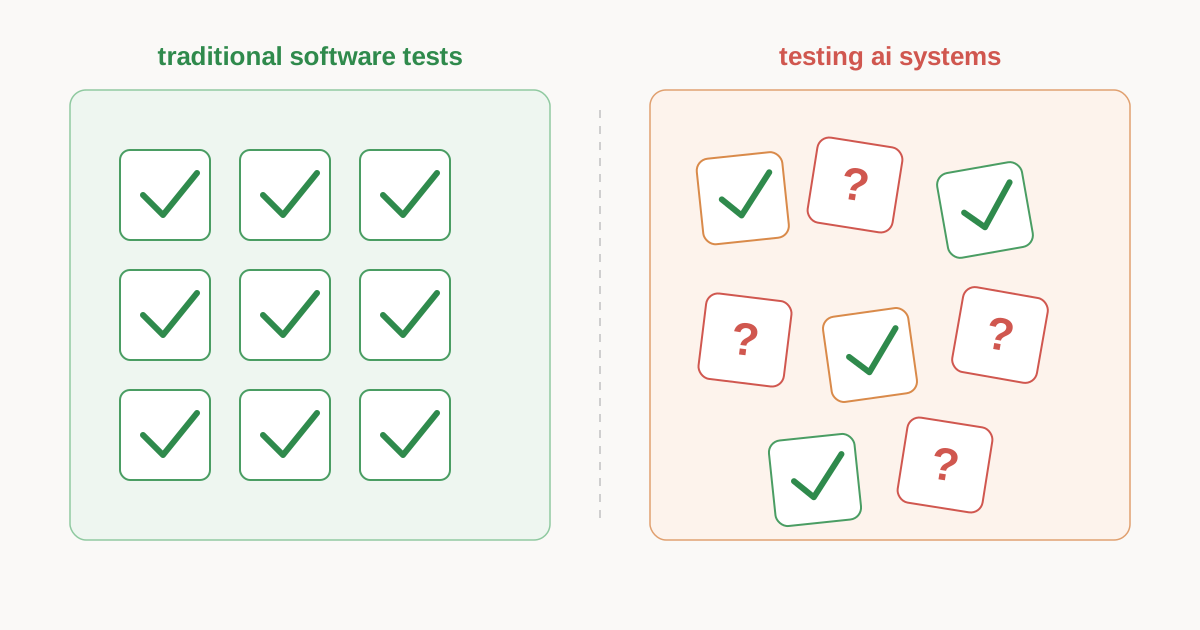
Traditional software is deterministic. Give it the same input a hundred times, and you get the same output a hundred times. That's what makes test suites possible in the first place. Write the assertion once, and it holds forever, or at least until someone changes the code.
AI systems don't work that way. Ask the same question twice and you can get two different, both reasonable, answers. That's not a bug you can patch. It's how the technology works.
This creates problems that don't have a name in the old QA vocabulary:
A support chatbot gives a confident, well-formatted, completely wrong answer. It's not a bug in the traditional sense, because nothing crashed and no exception was thrown. It's just wrong, and it sounded sure of itself the whole time.
A feature that worked fine in your test suite last month starts behaving differently this month, even though nobody on your team touched the code. Somewhere upstream, a model provider pushed an update. Your "passing" tests never noticed, because they were never designed to catch this kind of drift.
An input your team never considered an edge case turns out to be one. With deterministic code, edge cases are usually inputs at the boundaries: empty strings, negative numbers, max values. With AI, the "edge case" might be a completely normal-sounding sentence that happens to trip the model up in a way nobody predicted.
None of this shows up as a red X in a test runner. That's the real issue. The tooling says everything's fine while the product quietly isn't.
So how do you actually know it's safe to ship?
If pass/fail doesn't mean what it used to, what replaces it? I don't think there's one silver bullet here, and I'd be skeptical of anyone who claims there is. But there's a set of practices that, together, get you a lot closer to confidence than a traditional test suite ever will.
Test behavior, not exact output. Instead of asserting "the response must equal X," you assert "the response must satisfy these criteria": does it stay on topic, avoid making up facts, follow the tone you want, refuse the things it should refuse. This is closer to grading an essay than checking a math answer, and it takes a different kind of test to do it well.
Build a scenario set, not a fixed script. A traditional test script covers known paths. What matters more for AI is a living collection of real, messy, representative inputs, the kind your actual users type, including the weird ones. This set grows every time something goes wrong in production. Every failure becomes a new scenario you test against going forward, so the same mistake doesn't slip through twice.
Watch it after launch, not just before. Pre-release testing catches what you expected. It won't catch drift that shows up three weeks after a model provider updates something you don't control. Ongoing monitoring in production, with real usage data feeding back into your evaluation set, matters as much as anything you do before launch. Maybe more.
Put a human in the loop where the stakes are highest. You don't need a person reviewing every single output; that doesn't scale and it isn't the point. But for the interactions that matter most, a refund decision, a medical or legal question, anything customer-facing where a wrong answer costs trust, a human checkpoint is worth the friction.
Treat this as ongoing work, not a milestone. The biggest mental shift is probably this one. Traditional QA has a finish line: tests pass, ship it, done until the next release. AI QA doesn't really have a finish line. The model can change out from under you, your users can find new ways to break it, and the goalposts move on their own. That's uncomfortable if you're used to "tested" meaning "settled." With AI, it never quite settles.
What we've learned from doing this repeatedly
We've shipped six AI-native SaaS products in the past eight months at SociiLabs, and every one of them needed its own version of this shift. The pattern that holds across all of them: teams that treat AI QA like traditional QA end up finding problems from their customers instead of their test suite. Teams that build evaluation criteria, scenario sets, and monitoring from day one catch far more before it reaches anyone.
This is also why we push back on AI features that are AI in name only, a chatbot wrapper with no real evaluation behind it. If the testing approach hasn't changed, the AI probably hasn't actually been integrated into the product. It's been bolted on.
Where to start
You don't need to become a QA expert to get this right. You need a team that already thinks this way before the code gets written, not after something breaks in front of a customer.
If you're building or rebuilding an AI feature and want a second pair of eyes on how it should actually be tested, I'll put together a free 5-day Build Plan, no commitment, just a clear scope and timeline for what this would take.