
AI Compliance Reporting for Water Utilities: CCRs in Under 4 Hours
How SociiLabs helped WaterUp take Consumer Confidence Reports from days of manual work to under 4 hours per report, on a platform that reached production in 2.5 months.
Client · WaterUp
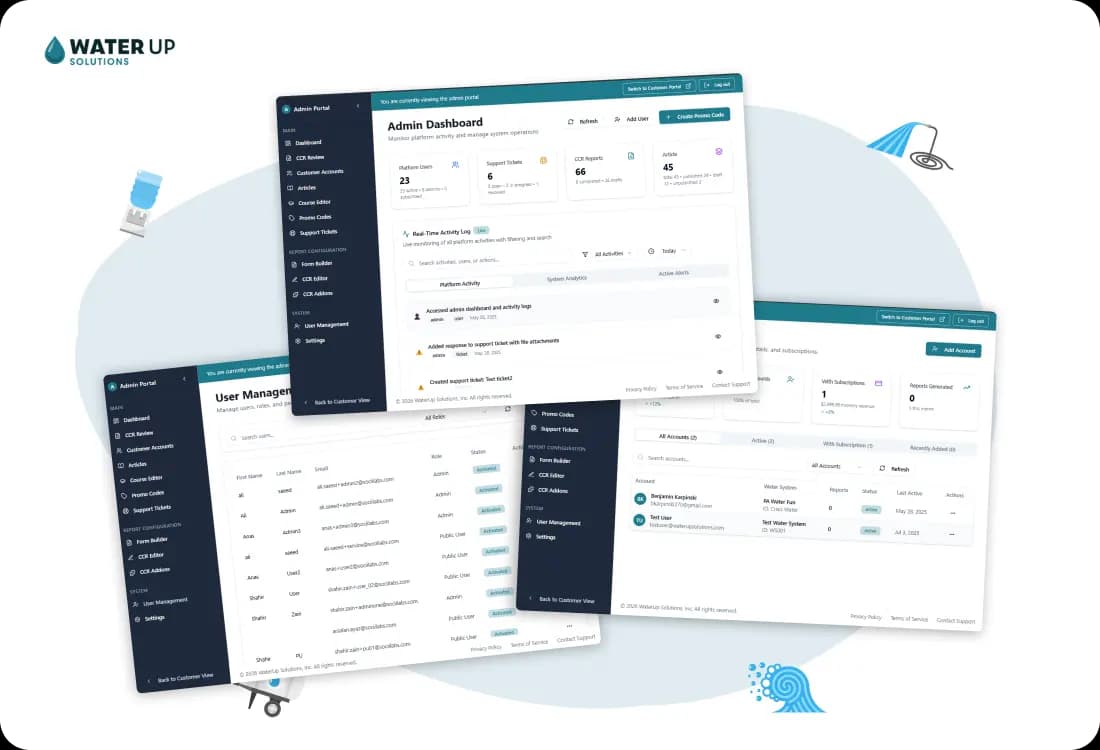
About the project
01 Project overview
Engagement
2.5 months from kickoff to production, now in beta
Delivery team
Senior SociiLabs engineers with a delivery lead
Core technologies
Vertex AI, RAG Q&A, Print-ready report output
WaterUp builds compliance software for community water systems, starting with the Consumer Confidence Report every U.S. utility must publish each year.
SociiLabs took the platform from discovery and architecture to production in 2.5 months. WaterUp is now in beta with water utilities, working to the same 1 July reporting deadline every community water system faces.
On WaterUp, a utility builds a print-ready Consumer Confidence Report in under 4 hours, work that used to take days, starting from 13+ report templates.
02 The challenge
Make annual compliance reporting fast and repeatable, without compromising regulatory accuracy or the public's trust.
01
The deadline is fixed, and the law behind it is real.
Under the Safe Drinking Water Act, every community water system must deliver a Consumer Confidence Report to its customers by 1 July. A late or inaccurate report is a violation. Small utilities face the same deadline as large ones, with a fraction of the staff.
02
The data lives everywhere.
Lab results, monitoring schedules, source-water details and violation records come from different labs, systems and spreadsheets. Each value has to land in exactly the right table, with the right units and detection limits.
03
Federal rules are only the baseline.
States layer their own requirements on top of EPA rules, and utility types differ in what they must report. One template can't serve every utility. The rules had to be encoded so each report adapts to its utility's state and type.
04
Every number is read by the public.
A CCR is the document residents use to decide whether to trust their tap water. Values had to be traceable to their source, and anything unusual had to be flagged for a person before it reached print.
Why SociiLabs
One team for the AI, the rules and the paperwork.
WaterUp needed a partner who could build an AI product for a regulated domain and have it ready before a legal deadline. The AI data-entry layer was only one part of the work. Our scope also covered the template engine, federal and state rule sets, anomaly flagging, a RAG Q&A layer, audit trails, print-ready output and multi-utility accounts. We built against the published regulations with WaterUp's team, tested templates against published reports, and shipped into WaterUp's own repository, where a senior engineer reviewed every line before merge.
What we built
03 Solution
The CCR builder, and the compliance system underneath it. AI-assisted data entry connects to rule-driven templates and print-ready output, with a person approving every flagged value.
AI Data Entry
Utilities upload lab reports and monitoring data in the formats they already have. The AI layer, built on Vertex AI, reads each value and places it in the right report section. Anything that doesn't fit cleanly is flagged for a person to review.
Template Engine
13+ pre-built templates cover the common utility types and reporting configurations. Each template assembles the required sections, tables and language automatically.
Regulatory Rule Sets
Federal requirements and state-specific rules are encoded as data. A utility's report picks up the right sections, health-effects language and thresholds for its state. Staff can ask questions in plain English and get answers grounded in the regulatory text through RAG Q&A.
Anomaly Flagging
Values outside expected ranges, unit mismatches and missing required fields are flagged for review. Every flag has to be cleared by staff before the report can go to print.
Audit Trail
Every value records its source document, who confirmed it and when. Reviewers can trace any number in the final report back to the lab result behind it.
Multi-Utility Accounts
Consultants and municipalities managing several water systems run all their reports from one account, with separate data and approvals for each system.
Architecture
System diagram
INSIDE A REGULATED PUBLIC-REPORTING WORKFLOW
AI where it saves hours. A person where the law requires one.
The AI layer proposes where each value belongs, and a utility staff member approves every flagged value before a report is finalised. Required sections can't be removed, and the report can't be exported until every mandatory field is complete. Each value keeps a link to its source document, along with a record of who confirmed it. Test runs use published historical reports, kept separate from live utility data. Every change to a report is logged, so a utility can show a regulator exactly how each number was produced.
Delivery timeline
Two and a half months to production. Then into beta with water utilities.
Discovery and architecture came first, so the data model and rule engine were settled before any template was built. The platform reached production 2.5 months after kickoff, and WaterUp moved into beta with water utilities. In beta, a report that used to take days is built in under 4 hours.
WEEK 1
Discovery & Architecture
Define the data model, rule engine and templates.
MONTH 2.5
Production Ready
AI data entry and 13+ templates in production.
AT LAUNCH
Beta Onboarding
Water utilities begin uploading their own data.
IN BETA
State Rule Sets
State requirements layered onto the federal baseline.
PER REPORT
CCRs in Under 4 Hours
From data upload to print-ready, down from days.
HOW IT STAYED ACCURATE
Every number traces back to its source.
DATA ACCURACY
Every value has a source.
Each value in a report links to the lab document and line it came from. Unit and detection-limit checks run on every value. A report can't be finalised while any check is still failing.
REGULATORY COVERAGE
The rules are tested like code.
Each template and state rule set is tested against published reports from real utilities. A change to a rule runs the full suite before it ships, so last year's correct report stays correct.
HUMAN APPROVAL
People sign off on what the public reads.
Flagged values, health-effects language and final reports all require a named approver. The approval record is kept with the report for the utility's compliance file.
SENIOR CODE REVIEW BEFORE PRODUCTION CHANGES
Every PR
CCR TEMPLATES TESTED AGAINST PUBLISHED REPORTS
13+
FLAGGED VALUES CLEARED BY A PERSON BEFORE PRINT
Every flag
04 Impact & results
Impact & Results
Reports built in hours. Every value traceable. Production in 2.5 months.
- Print-ready Consumer Confidence Reports generated from a utility's own lab and monitoring data, built around the 1 July deadline every community water system works to.
- Under 4 hours per report from data upload to print-ready CCR, compared with the days the same report took as manual work.
- 13+ report templates by utility type, so each report starts with the right sections, tables and required language already in place.
- Anomaly flagging before print, catching unit mismatches, out-of-range results and missing required fields for staff review.
- Every value traceable to its source document and the person who approved it. WaterUp is in beta, so this page covers the platform's design and per-report build time.
- 2.5 months from kickoff to production, with AI data entry, rule sets and print-ready output in place for beta utilities.
Time to build a print-ready CCR, down from days
< 4 hrs
Kickoff to production
2.5 mo
Pre-built CCR templates by utility type
13+
Your product roadmap is waiting on engineering. We ship it.
SociiLabs has shipped 10 projects in 2025–2026 and is rated 5.0 on Clutch. Senior engineers, fixed-scope sprints, and your repo, your cloud, your IP from the first commit.
Book a discovery call