
AI Marketing Platform for Growing Brands: 4 AI Modules in 4 Months
How SociiLabs helped Navia's non-technical founder take a four-module AI marketing suite from idea to production in 4 months, with an average AI response under 4 seconds.
Client · Navia · thenavia.com
About the project
01 Project overview
Engagement
4 months, idea to production
Delivery team
Senior SociiLabs engineers with a delivery lead
Core technologies
Next.js, Node.js, PostgreSQL, prompt orchestration, async job queue
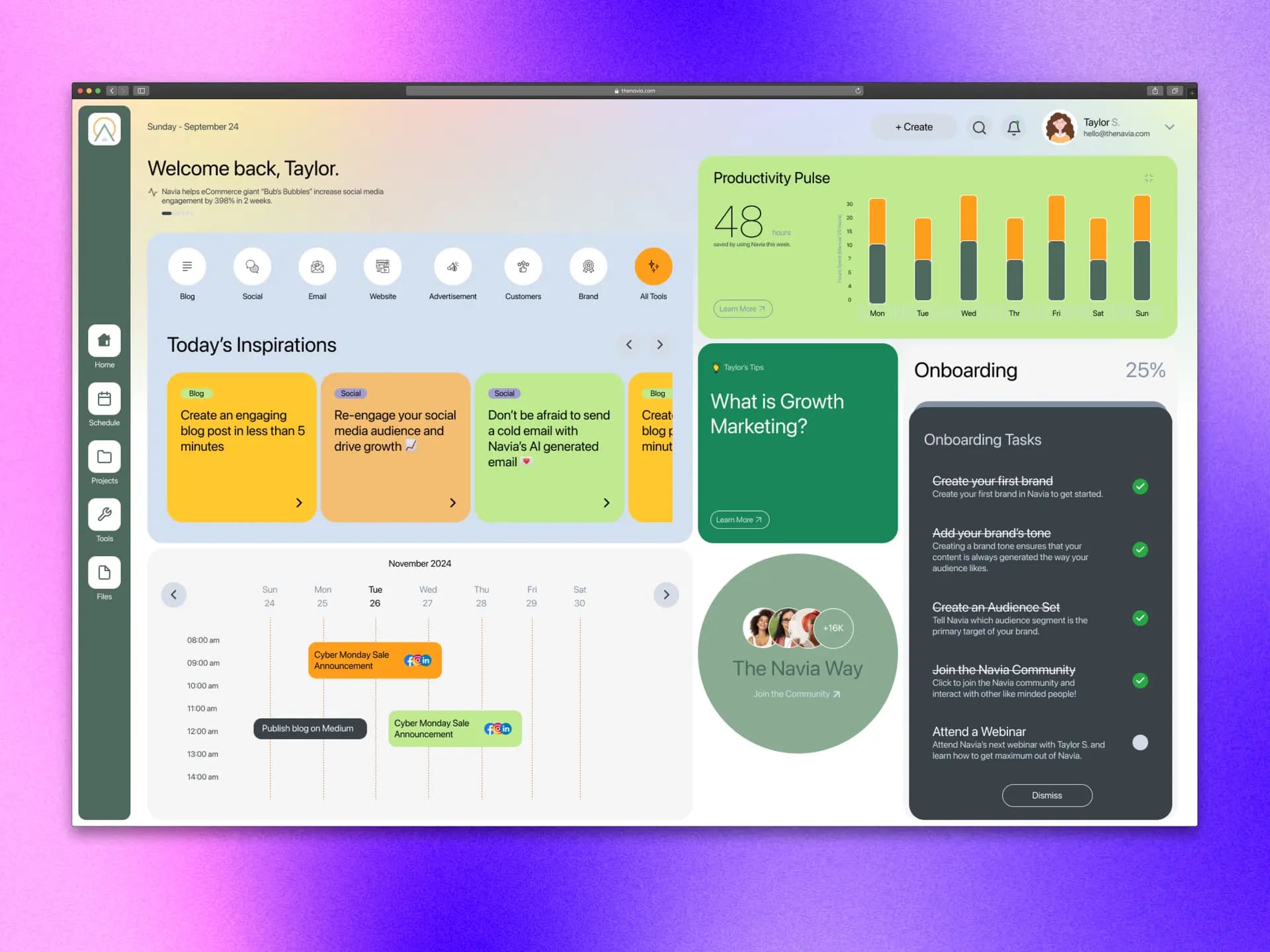
Navia is an AI marketing platform that helps growing brands plan, write and schedule their marketing from one workspace. Its founder, Taylor Smith, came to SociiLabs with a clear product vision, no engineering background and four modules to ship as one platform.
Taylor's first plan was to build on WordPress. We recommended an AI-ready stack instead, and four months from idea to production, Navia launched with all four modules live: Content Engine, Brand Manager, Task AI and Admin.
Navia is live today with paying subscribers. Its average AI response, from prompt to first draft, is under 4 seconds.
02 The challenge
Ship four AI products as one platform in four months, without losing speed, brand consistency or the founder's ownership of the IP.
01
Four modules, one product.
Content generation, brand management, task planning and admin each needed their own logic. A user had to feel they were in one workspace, with one brand profile feeding every output. Four separate tools stitched together would have broken that experience.
02
AI workloads need an AI-ready stack.
LLM calls are slow, sometimes fail, and cost money on every request. A platform built around them needs background queues, retries and per-user state from the first commit. WordPress, where Taylor planned to start, was never designed for that kind of workload.
03
Every brand sounds different.
A bakery and a SaaS startup can't share a prompt. Tone, audience and product details had to flow into every generation, so a user never has to explain their brand twice.
04
A founder's timeline is a runway.
Taylor needed a launch date that marketing and pricing could be planned around. The build had to land in four months with architecture, design, engineering and QA owned by one team.
Why SociiLabs
One team from architecture to launch day.
Taylor needed a technical partner who could act as a founding engineering team. The AI features were only part of the job. Our scope also covered the stack decision, product design, the orchestration layer, the job queue, billing-ready accounts and the deployment pipeline. At discovery we talked Taylor out of WordPress and into an AI-ready stack of Next.js, Node.js and PostgreSQL. A senior engineer reviewed every change before merge, the repository belonged to Taylor from the first commit, and when a deadline was at risk, we said so early.
What we built
03 Solution
The AI marketing suite, and the orchestration system underneath it. Four modules share one brand profile, one prompt layer and one job queue, so every output sounds like the same brand.
Content Engine
Blog posts, social captions, emails and ad copy from a single brief. Drafts land in the content calendar, ready to edit or schedule.
Brand Manager
One profile per brand holds tone, audience, offers and banned phrases. Every module reads from it, so a user sets up their brand once.
Task AI
Turns a marketing goal into a weekly plan of tasks with due dates and suggested content. The productivity view tracks what got done.
Prompt Orchestration
A shared layer of versioned templates, brand-voice injection and model routing. A prompt improvement ships once and reaches all four modules.
Background Job Queue
Long generations run asynchronously with automatic retries, so the interface stays responsive. A failed job retries with backoff instead of handing the user an error.
Admin + Onboarding
Guided onboarding walks a new user from sign-up through their brand profile to a first scheduled post. Admin tools manage accounts, subscriptions and usage.
Architecture
System diagram
INSIDE A MULTI-BRAND AI CONTENT PLATFORM
Automated where the brand is clear. The user in control where it counts.
Every generation reads the brand profile first, so outputs stay on tone without manual prompting. Nothing publishes without a user scheduling it. Drafts stay drafts until a person approves them. Per-account usage limits keep costs predictable, and fallbacks for rate limits and outages keep the platform available when a model provider slows down. Brand data is scoped per account, so one brand's profile never shapes another brand's output.
Delivery timeline
Four months from idea to production. Then paying subscribers.
Discovery set the stack, the brand model and the orchestration layer. Four months from idea, Navia reached production with all four modules live. It now runs with paying subscribers.
WEEK 1
Discovery & Architecture
Define the stack, the brand model and the orchestration layer.
PHASE I
Shared Foundation
Brand profiles, prompt orchestration and the async job queue.
PHASE II
Four AI Modules
Content Engine, Task AI and Admin built on the shared prompt layer.
MONTH 4
Production Launch
All four modules live on day one.
AFTER LAUNCH
Paying Subscribers
Navia runs live, on code and IP the founder owns.
HOW IT STAYED FAST
Every generation runs through one layer, from prompt to output.
RESPONSE SPEED
Slow work happens in the background.
Anything that takes longer than a few seconds moves to the job queue, and the interface updates when it finishes. Users keep working while long-form content generates. The average AI response stays under 4 seconds.
BRAND CONSISTENCY
One profile feeds every module.
Brand Manager is the single source for tone, audience and offers. Prompt templates are versioned, so a change to how Navia writes is tested and released like code.
OPERATIONAL CONTROL
Failed jobs retry on their own.
Failed AI jobs retry automatically with backoff, and model routing falls back when a provider hits a rate limit or outage. Usage limits per account keep model costs predictable as the user base grows.
SENIOR ENGINEER REVIEW BEFORE PRODUCTION MERGE
Every PR
BRAND PROFILE FEEDING ALL FOUR AI MODULES
1
REPOSITORY AND IP OWNED BY THE FOUNDER FROM
Day 1
04 Impact & results
Impact & Results
Four AI modules shipped. One brand profile behind every output. Live with paying subscribers.
- 4 months from idea to production, with all four modules live on day one: Content Engine, Brand Manager, Task AI and Admin.
- Live with paying subscribers, generating blog, social, email and ad content from one brand profile per account.
- Under 4 seconds average AI response, from prompt submission to first draft.
- Long generations run in a background queue with automatic retries, so a slow model call never freezes the interface. Usage and reliability figures will be published as Navia's subscriber base grows.
- Guided onboarding from sign-up to first scheduled post, built around the brand profile so a new user explains their brand once.
- 100% of the codebase and IP owned by the founder, with per-account usage limits keeping model costs predictable as subscribers grow.
Idea to production, with all four AI modules live
4 mo
Average AI response from prompt to first draft
< 4 s
Codebase and IP owned by Navia's founder
100%
Your product roadmap is waiting on engineering. We ship it.
SociiLabs has shipped 10 projects in 2025–2026 and is rated 5.0 on Clutch. Senior engineers, fixed-scope sprints, and your repo, your cloud, your IP from the first commit.
Book a discovery call